
Spirometry lung function & physiology
Bringing physiology and lung function to life. A unique collection of animations explaining spirometry and respiratory physiology, coupled with dozens of videos of patients being taught spirometry and videos of their real-time flow volume loops. Most are accompanied by explanations by a Professor of Respiratory Medicine.
EXAMPLES
Below is a selection of sample videos from this accelerator library
COPD: severe airways obstruction
This patient has very severe COPD. With his first blow, you can see a marked reduction in his FEV1 which is only 23% predicted. His FVC is 72% predicted, 3.2 litres. His FEV1/FVC ratio is only 29%. The respiratory physiologist feels that he could have blown out harder initially and possibly for longer. It is important to remember that this patient’s vital capacity may well be higher than his forced vital capacity. When performing a forced vital capacity air trapping is likely to occur in such a patient. If they breathed out slowly, they are likely to breathe out more air as their intrathoracic pressure would be less and less gas trapping would occur. We would advise starting this Spirometry session by measuring his relaxed slow vital capacity.
Spirometry: stopping breathing out too soon
The initial part of the flow volume is excellent. However, the subject suddenly stops breathing out when they could still have exhaled more air. When this happens the expiratory curve suddenly goes down to the baseline. This is explained to the subject who then performs a full expiratory manoeuvre. You can see this has increased his force vital capacity from 4.96 litres, 87% predicted, to 7.11 litres, 124% predicted.
Spirometry with forced expiration
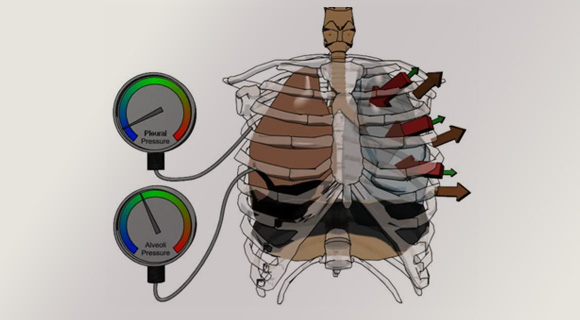
Look at the video of the author performing a forced expiratory manoeuvre during a research bronchoscopy. You see a marked narrowing of the major airways during the procedure; you can see that when the pressure is greater outside the airways during forced expiration there is compression of them – indeed they are being held open by their cartilaginous support. In the trachea, you can see the muscular posterior wall is pushed inwards by the force generated. There is some evidence that even at lung volumes near patients’ total lung capacity i.e., when they have breathed in as much air as they can, the flow may be limited. Airway compression always occurs first in the trachea. The horseshoe-shaped cartilaginous rings have a dorsal membranous part, which easily gives way to pressure. This narrow airway segment functions as a check valve where the speed of gas molecules is limited to the speed at which the wave can propagate in the airway wall and is no longer governed by air pressure difference from airway to mouth.
Inspiratory and expiratory flow volume loop
On this graph, we see the spirogram at the top and the flow volume loop underneath it of a patient drawn at the exact same time. The animation models a patient breathing in and out with tidal breaths, then, taking as deep a breath as they possibly can and then blowing out as hard and as fast as they can for as long as they can, before taking a full breath in. It is worth playing through this on a few occasions so you can see which point on the spirogram corresponds to the same point on the flow volume loop. On the spirogram the y-axis is volume.